Gauss Cannon, Lichtfeld, and Controllable Capture
Small but satisfying breakthrough today: using Gauss Cannon in Blender to turn arbitrary mesh geometry into controllable camera placement for Gaussian splat capture. This kind of thing used to take FOREVER and be painfully manual, or take very long to script properly.
Here it is in all its web-based, interactive, embedded glory:
(More on that later.)
The main useful conceit I haven't seen done anywhere else is that the mesh becomes a capture instrument. Each face can become a camera position, which means the shape of the mesh becomes the shape of attention:
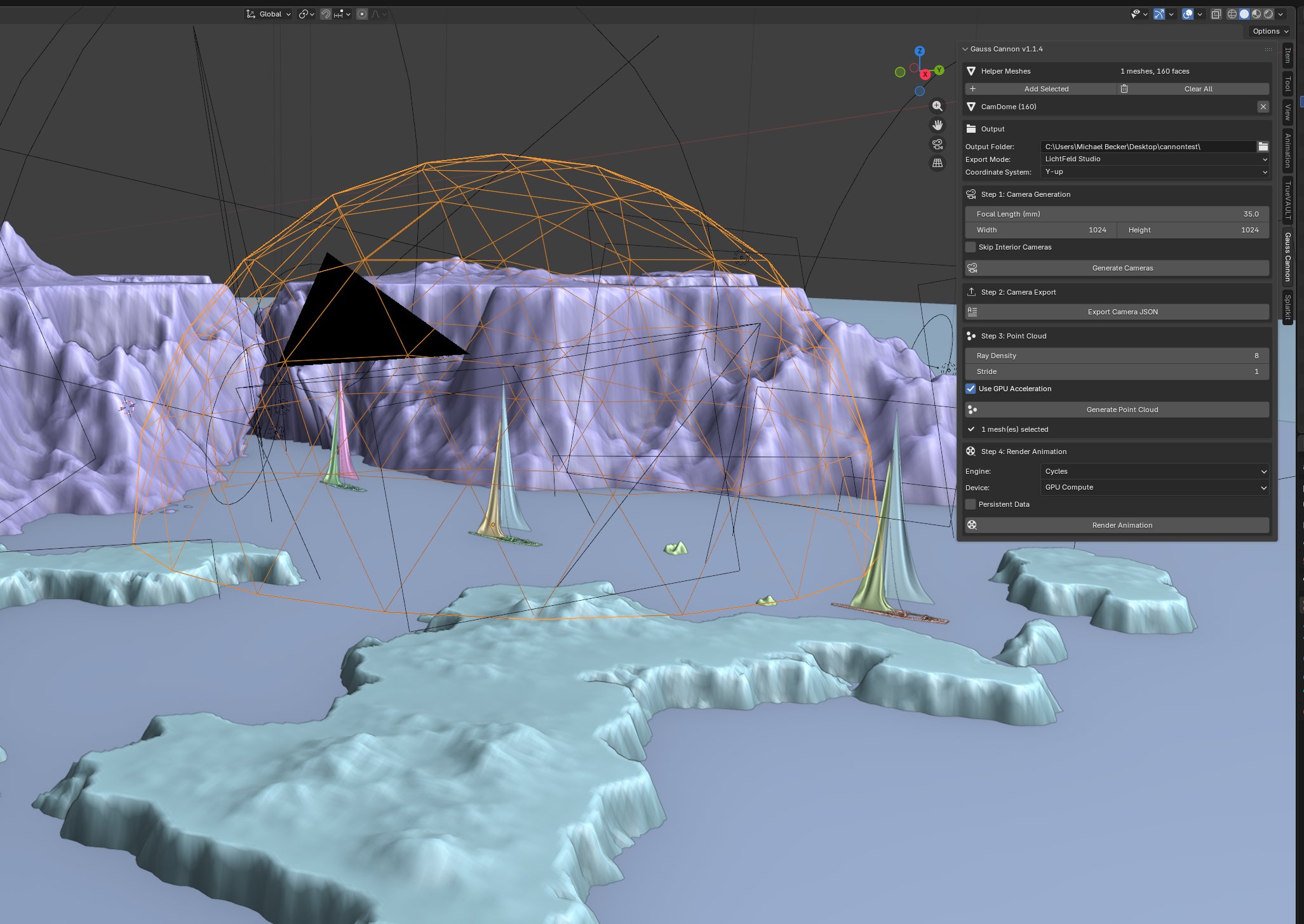
e.g A dome gives an outside-in capture volume. A half-sphere keeps the camera field above the ground plane. Multiple overlapping forms can emphasize different regions of the scene. Inside-out and outside-in capture become matters of geometry, not bespoke camera rigging. And of course, subdivision becomes camera density / rendered frame count.
All these variables can be painfully crucial for the quality of the final splat - so being able to control them so intuitively and iterate quickly on the capture front matters a great deal. Major props to Warpgate labs for creating this lovely little (free!) utility.
Gauss Cannon also extracted the (immensely helpful, Don't-splat-without-them) camera extrinsics (transforms) and point cloud automatically, then packaged the results into a Lichtfeld-compatible structure. Dropping the output into Lichtfeld and training using default settings worked immediately.
This results in a delightful little toolchain: Blender scene → intentional camera geometry → rendered frames → camera extrinsics → point cloud → Lichtfeld training package → working splat.
The next step is presentation. I wanted these captures to be viewable directly on the site, not merely described. (As you can see above, this is in fact what's going on)
For now, the sane path is probably to embed a third-party or lightweight web viewer rather than write a custom renderer immediately. SuperSplat is a strong browser-based option for inspecting, editing, optimizing, and publishing splats, and Spark is compelling if I want splats to become first-class objects inside a custom Three.js scene later. Spark’s own positioning is specifically as an advanced Gaussian Splatting renderer for Three.js, which makes it a good fit for eventual deeper integration. But for now, SS gets it done quickly and effortlessly.
What I'm really interested is 4DGS and the near-future of authoring spatial video and VFX in increasingly interoperable / approachable ways. But this work is mostly about estabilishing the basics.
For now, I think Blender->Gauss Cannon->Lichtfeld will be my baseline for these experiments.
- Lichtfeld, incidentally, is superb - what Postshot used to be in the early days. Support the creators of this excellent OSS tool!